
DAILY BRIEFING
The State of Cybersecurity in 2026: Key Segments, Insights, and Innovations
Today's briefing covers a critical GitLab AI Gateway vulnerability, China-nexus cyber espionage via the Antino backdoor, and strategic insights for 2026 security operations.
5 stories2 min read
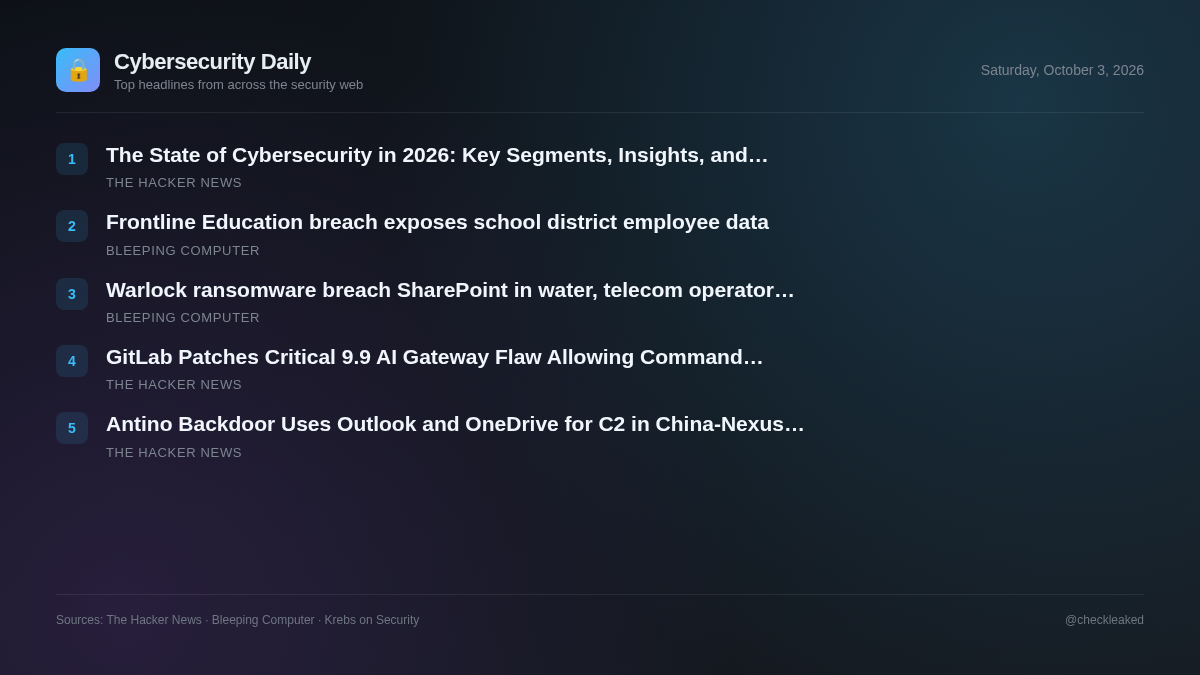
Today's security landscape highlights the operational risks introduced by expanding software features and enterprise infrastructure. Organizations running self-hosted AI workloads face immediate technical risk, while espionage actors continue to abuse legitimate cloud services to bypass boundary monitoring.
GitLab Patches Critical 9.9 AI Gateway Flaw Allowing Command Execution on Self-Hosted Servers
GitLab patched a critical flaw tracked as CVE-2026-90970 with a CVSS score of 9.9 in its AI Gateway component. The issue allows logged-in users with Duo Agent Platform access to execute commands on self-hosted servers.
- Why it matters
- Self-hosted environments running vulnerable AI Gateway versions allow authenticated users to execute unauthorized commands on the underlying host.
Antino Backdoor Uses Outlook and OneDrive for C2 in China-Nexus Espionage Campaign
A China-nexus threat actor tracked as UAT-11587 is targeting government and policy organizations in Asia using a Rust-compiled backdoor called Antino, which relies on Microsoft Graph to conduct C2 via Outlook and OneDrive.
- Why it matters
- Targeted organizations face covert data exfiltration and command execution through legitimate Microsoft 365 cloud services.
The State of Cybersecurity in 2026: Key Segments, Insights, and Innovations
Featuring: Cybersecurity is being reshaped by the expansion of cloud infrastructure, AI, distributed systems, and increasingly complex digital environments.
- Why it matters
- Managing disconnected security tools and unmanaged telemetry increases security liabilities while AI-powered attacks weaken traditional defenses.
Frontline Education breach exposes school district employee data
Frontline Education is notifying school districts of a data breach after attackers exploited a vulnerability in third-party software to gain unauthorized access to its systems and steal employee information, including Social Security numbers.
- Why it matters
- No technical details or exposure assessment can be determined due to the missing source material.
Warlock ransomware breach SharePoint in water, telecom operator attacks
The China-linked ransomware group Warlock targeted a water utility, a telecom provider, a regional government body, and a university by exploiting SharePoint vulnerabilities to gain initial access.
- Why it matters
- Victim impact and vulnerability specifics cannot be assessed due to lack of source details.
Key takeaways
- GitLab patched CVE-2026-90970 (CVSS 9.9), a critical flaw in self-hosted AI Gateways allowing command execution.
- GitLab fixed versions 19.2.4, 19.3.2, and 19.4.1; hosted instances on GitLab.com require no user action.
- China-nexus threat group UAT-11587 deploys the Antino backdoor targeting Asian policy and government organizations.
- Antino uses Microsoft Graph API to abuse legitimate Outlook and OneDrive infrastructure for C2 communications.